Specialist Nurse–Led Wound Care for Efficient Healing of a Stage 4 Pressure Injury
by YDCare Homecare Team
|
February 11,2026
Mr. Chan is a old aged home resident. Due
to advanced age and multiple chronic diseases, he becomes more and more
dependent and bed bounded. As a result of extremely limited mobility and
persistent incontinence, a severe pressure injury developed over the sacral
area.
The old aged home nursing team had been
providing routine wound care and daily nursing support, including basic
cleansing and dressing changes. However, due to limitations in resources, more
advanced wound management and professional wound care techniques could not be
implemented. The wound condition remained recurrent and showed no significant
improvement over an extended period.
As the risk of further deterioration became
increasingly apparent, the family decided to seek external professional wound
care support, hoping to secure a more effective and targeted treatment approach
for Mr. Chan.
Comprehensive Assessment by a YDCare
Specialist Nurse
In October 2025, YDCare’s wound care
specialist nurse conducted an on-site comprehensive assessment. The evaluation
confirmed a Stage 4 pressure injury, with deep tissue involvement and bone
exposure, alongside coexisting incontinence-associated dermatitis (IAD).
After thoroughly assessing wound depth,
peri-wound skin condition, and Mr. Chan’s overall
health status, YDCare developed a treatment plan centered on Negative Pressure Wound Therapy (NPWT). The plan was designed to integrate with existing old aged
home measures, with the aim of reducing infection risk and improving overall
wound healing efficiency.
Phased Treatment Approach with
Progressive Wound Healing
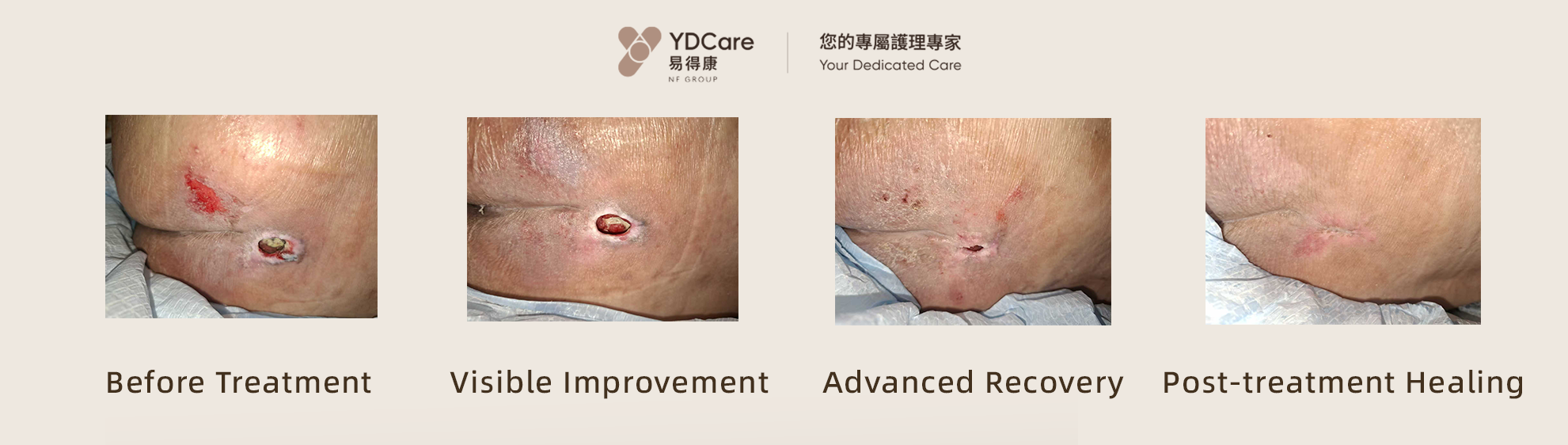
During the initial phase of treatment, Mr.
Chan received approximately two months of S&N Renasys NPWT, combined with
professional debridement and appropriate wound bed preparation. This approach
effectively controlled wound exudate, promoted granulation tissue formation,
and gradually improved the condition of the deep wound bed.
Subsequently, a one-month of S&N PICO
was implemented during the final recovery phase. This supported the transition
toward wound closure by maintaining a stable healing environment and
facilitating continued tissue repair.
The pressure injury was managed
specifically with NPWT, while the coexisting incontinence-associated dermatitis
was also treated. We were using dedicated skin protection and incontinence care
products. This holistic care approach ensured optimal treatment outcomes for
both conditions.
YDCare’s wound care team also proactively
liaise with the old aged home nursing staff, proposing and coordinating
specific care measures—such as the use of
pressure-relieving air mattresses, repositioning every four hours, and
optimized incontinence care—to ensure alignment with
the overall wound management strategy. In addition, YDCare arranged a dietitian
to focus on enhancing protein intake to support wound healing from a
nutritional perspective.
Specialist Nurse–Led Care: Saving Time and Reducing Overall Costs
Throughout the care planning process, the
family was particularly concerned about long-term costs and the predictability
of treatment outcomes.
If care had relied solely on daily visits
by general nurses for basic wound cleansing, the monthly service fees alone
could have exceeded the total cost of a specialist nurse–led care plan. In some cases, such expenses may reach more than
double the cost of a comprehensive wound specialist nurse-led package that
includes specialist assessment, wound care, debridement, advanced dressings,
and NPWT consumables.
More importantly, basic wound care alone
does not effectively address deep Stage 4 pressure injuries and offers limited
ability to predict healing timelines. Families are often left facing prolonged
and open-ended expenses without clear expectations of wound improvement or
closure.
In contrast, a treatment pathway led by a
wound care specialist nurse beginning with thorough clinical assessment and
followed by the appropriate use of advanced wound care technologies, allows for
more precise intervention tailored to the wound’s
actual condition.
This approach facilitates wound healing
within a clearer timeframe, enabling families to make more informed decisions
regarding both clinical outcomes and financial planning. For complex, deep, and
long-standing pressure injuries, goal-oriented specialist nurse intervention is
often significantly more time-efficient and cost-effective than repetitive
basic care alone.
Want to Seek Help?
If a family member is experiencing
recurrent wound deterioration or prolonged wound care with little improvement,
early assessment by a wound care specialist nurse can be a critical turning
point in the treatment journey.
YDCare provides specialist nurse–led home-based wound assessment and treatment services, including
NPWT, debridement, dressing selection, and cross-disciplinary care
coordination. Our team supports families in navigating complex wound conditions
with clearer treatment direction and more predictable outcomes.
For further information or to discuss a
care plan tailored to your family member’s needs,
please feel free to contact us.